
Monday, December 27, 2010

Pandorama on reappear trail


Meade hopeful Pandorama can get his season back on track

Noel Meade is hoping that Pandorama will enjoy a welcome change of luck on today’s Lexus Chase at Leopardstown.

The seven year old looked set to take high rank in the staying pursues division at the start of the season but things have not gone according to plan so far.

He was forced to miss an intended run at Down Royal after he was found to have blood coming from a nostril and then he made an early fault in the Hennessy at Newbury before being nearly brought down and was pulled up.

"Hopefully we can get Pandorama back on track but it's a rough ask for him," said Meade.

"The season just hasn't gone right for him so far, things have plotted against him but that's the way it goes.

"We've always thought he is the horse to run in this type of race, so we're going there and we're going to give it our best shot.

"The heavy ground should be fine for him."

Sunday, December 26, 2010

Super bug! World’s strongest insect discovered


After months of demanding tests, a species of horned dung beetle takes the title for world's strongest insect.

The beetle, called Onthophagus taurus, was found to be able to pull an enormous 1,141 times its own body weight, which is the equivalent of a 150-pound (70-kilogram) person lifting six full double-decker buses. While the study researcher knows of a mite that can take on a hair more, that organism is an arachnid, not an insect.

The finding, published in the current subject of the Proceedings of the Royal Society B, does more than elevate the beetle's status, as it lends insight to questions of evolutionary biology.

The beetles aren't the dung-ball-carrying variety, and instead the females bury most of the fecal material from, say, cow droppings.

The females build little tunnels, where they lay their eggs in the dung. It's within this tunnel that mating, and the pre-mating fightsbetween waiting males, takes place. But not all males are equipped for battle. Some sport horns while others are hornless. The no-horn beetles instead wait at the tunnel's entrance, sometimes hiding out in self-built side tunnels, and sneak in to mate before they're caught by a horned male.

The horned males, on the other hand, duke it out head-to-head.

"Their horns kind of meet on the shoulders, and they push each other backward and forward, and the guy being pushed will brace when pushed in the tunnel," Rob Knell from Queen Mary, University of London told LiveScience.

Thursday, December 23, 2010

Belgian man finds £255,000 while refurbishing an old bank


A Belgian man refurbishing a house in Ghent found £255,000 in cash that had been left behind available from when the building had housed a bank almost 10 years ago.

Ferhat Kaya, 33, had bought the property, a former branch of the Dexia bank, at a cost of £153,000 to house his accounting firm and before accepting the keys turned down the estate agent's quote of £3,000 to take away an old safe.

Instead he called two close friends, the brothers Murat and Hurun Tufan to remove the metal vault. "When the vault was open it exposed bags of 20 and 50 euro bills," said Murat Tufan. "The receipts were still there, dated December 31, 2001. We started counting, and it came to some 300,000 euros."

After speaking to his Turkish father, Mr Kaya decided to call the police even though it would have been easy to keep the cash as it had been lost and left unwanted by the bank for almost a decade.

"My friends and I thought we would really make a statement with it: that even immigrants are people that say honesty is the best policy," he said.

Ulrike Pommée, a spokesman for Belgium's Dexia Bank, said that an investigation had been opened but suggested that no trace of money would ever be found.

World's time is up in 2012 as 'Armageddon will destroy Earth', campaigners believe


The world’s time is up in 2012, the year of Armageddon, according to both Nostradamus and Mayan prophesy.

Several “eclectic authors” claim that a “major, world-changing event” will take place during the same year of the London Olympics and the Queen’s Diamond Jubilee.

According to campaigners, 2012 is a “year of spiritual transformation”.

The doomsday theorists quote the 1995 book, The Mayan Prophecies, which links the Maya calendar with long-period sunspot cycles. A Mayan elder has since dismissed those suggestions.

Another book, The Nostradamus Code, details a series of natural disasters caused by a comet… which will allow “the third anti-Christ to disperse his troops around the globe under the guise of aid in preparation for a nuclear war”.

“2012 is someverdana claimed to be a year of spiritual transformation

Wednesday, December 22, 2010

Woman’s Body Is Found in Suitcase


The body of a woman was found on Wednesday in a suitcase that had been left on a street in East Harlem, the authorities said.

A man fumble in the street found a large black suitcase just outside 435 East 114th Street about 12:15 a.m., according to a law enforcement official. The case, which was conserved, was at or near where garbage is normally placed in front of the building.

As the man began to open the bag, a leg popped out, said Paul J. Browne, the Police Department’s chief spokesman. The man quickly called 911.

“The person walking by found the case and opened it to see if there was anything important in it,” the official said. “And found a body.”

The victim, a 28-year-old woman whose last known address was in the Bronx, was fully clothed, and the upper half of her body was in a black garbage bag, Mr. Browne said. Her name has not been released pending notification of her family.

It was not immediately clear how long she had been dead or how she was killed, but there was apparent trauma to her head, and blood had pooled inside of the suitcase, Mr. Browne said.

Supercomputer made out of 1,760 PS3s


The US Department of Defence has revealed its fastest interactive computer - made out of 1,760 Playstation 3 consoles. Dubbed the Condor Cluster, the new system is capable of performing 500 trillion floating point operations per second. It will be used for quickly processing high-res satellite imagery, radar enhancement, and even research into artificial intelligence.

The consoles were used as they provide maximum computing power at a budget price. When the project began four years ago PS3s cost around £250 each, while the equivalent technology would have been about £6,500 per unit.

Officials also say the Condor will also consume less than one-tenth the power of comparable supercomputers making it a "green" supercomputer. Mark Barnell, director of US Air Force Research Laboratory High Power Computing, said: "Such capability exceeds any other interactive supercomputer currently used by the Department of Defense." Based at the Air Force Research Laboratory in New York, the array also uses 168 GPUs and 84 servers to direct system traffic.

The older 'fatter' Playsation 3 consoles were used as they allow installation of the Linux operating system.

Tuesday, December 21, 2010

Girl With 2 Hearts Amazes Doctors


Here is an incredible story about Hannah Clark. She is a 16-year-old year girl with a shy laugh and a love of animals and babies. She likes to go shopping with friends and dreams of a career working with children.

But Hannah Clark is not an ordinary teenager and her normal life today could not have been possible without a unique, life-changing heart surgery. In 1994 when she was eight-months-old, Hannah was diagnosed with cardiomyopathy — an inflammation of the heart muscle that impairs the heart’s ability to work properly.

Hannah’s heart was failing and she needed a transplant. But instead of taking her own heart out, doctors added a new donated heart to her own when she was just two-years-old. The so-called “piggyback” operation allowed the donor heart to do the work while Hannah’s heart rested. But Hannah was not in the clear yet. As with any organ transplant, Hannah’s body was likely to reject her new heart and she had to take powerful immune suppression drugs.

Those drugs allowed her body to accept the donor heart but also led to cancer and yet another medical battle for Hannah that lasted for years.  Nearly 11 years after receiving the extra heart, there was more bad news: The immuno-suppression drugs were no longer working. Hannah’s body was rejecting the donor heart.

In February 2006, her doctors tried something that had never been done before: They took out the donor heart. Doctors theorized that the donor heart had allowed Hannah’s heart to rest, recover and grow back stronger.  Now for the first time Hannah’s father, Paul Clark, describes the agonizing decision the family had to make at the time: “If she’d never had it done, she wouldn’t be here.

“In the very beginning it was a 50/50 chance she wasn’t going to make the operation. But in the next one it was even greater because it had never been done before. But we had to take that risk,” he told. The doctors were right. Three years later, Hannah has no need for any drugs and has been given a clean bill of health. The operation was a success.

“It means everything to me,” Hannah told after the pioneering operation. “I thought I’d still have problems when I had this operation done. I thought after the heart had been removed I thought I’d have to visit hospitals. But now I’m just free,” she said, smiling. Dr. Magdi Yacoub performed Hannah’s original transplant and came out of retirement to perform the second.

The possibility of recovery of the heart is just like magic.” Dr. Yacoub said at a media conference. “We had a heart which was not contracting at all at the time. We put the new heart to be pumping next to it and take its work, now it is functioning normally.”

The findings have been published in the British medical journal, this seems like a true miracle.  I am curious how the old heart was able to still beat, because you think as a muscle that was not being used it would have went into atrophy.

'Singing Mouse' Made With Genetic Modification


Japanese scientists said Tuesday they had produced a mouse that tweets like a bird in a genetically engineered "evolution" which they hope will shed light on the origins of human language.

A team of researchers at the University of Osaka created the animal in their "Evolved Mouse Project," in which they use genetically modified mice that are prone to miscopying DNA and thus to mutations.

"Mutations are the driving force of evolution. We have cross-bred the genetically modified mice for generations to see what would happen," lead researcher Arikuni Uchimura said.

"We checked the newly born mice one by one... One day we found a mouse that was singing like a bird," he said, noting that the "singing mouse" was born by chance but that the trait will be passed on to future generations.

"I was surprised because I had been expecting mice that are different in physical shape," he said by telephone, adding that in fact the project had also produced "a mouse with short limbs and a tail like a dachshund."

The laboratory, directed by professor Takeshi Yagi at the Osaka University's Graduate School of Frontier Biosciences in western Japan, now has more than 100 "singing mice" for further research.

Considering that mutant mice tweet louder when put in different environments or when males are put together with females, Uchimura said their chirps "may be some sort of expressions of their emotions or bodily conditions."

"I know it's a long shot and people would say it's 'too absurd'... but I'm doing this with hopes of making a Mickey Mouse some day," he said.

Monday, December 20, 2010

Deadly earthquake hits Iran

Earth quake

At least seven people are dead and three villages destroyed in the quake that jerked a vast region in the south east. An earthquake in southeast Iran has killed at least five people and shattered homes, a regional governor has said.

The quake struck late on Monday in a mountainous region and was given a 6.3 magnitude by the US Geological Survey. Kerman province is said to be the worst affected area. "Seven people have been killed and hundreds have been injured. Hundreds of people are motionless trapped under the rubbles," Esmail Najjar, governor of Iran's Kerman province, the centre of the quake, told the semi-official Mehr news agency.


There were nine aftershocks following the earthquake, one that was given a 5 magnitude, according to IRNA, the official news agency. Mohammad Javad Kamyab, an employee of Kerman province governor's office, said that 30 villages lay in the affected area.

"These villages are not heavily populated ... We are not expecting a high death toll and so far 25 people have been injured," Kamyab said. Telephone lines were down while rescue teams have been dispatched, according to authorities.

Some reports said that the quake was felt in Sistan-Baluchestan province, including the towns of Zahedan, Bam, Khash and Iranshahr. However, there were no reports of damage in those locations.
In 2003, Bam was the scene of a devastating earthquake that killed more than 26,000 people.

A dog in Germany gives birth to 17 puppies


A dog in Germany has given birth to 17 puppies, leaving their owner thrilled but fatigued after having to feed them with a urn for several weeks because their mother couldn't cope with the demand.

Owner Ramona Wegemann said Monday she barely slept for more than a couple of minutes without interruption during about four weeks in a "very tiring" struggle to make sure all of the purebred Rhodesian Ridgeback puppies would survive.

She said when she was "finished feeding the last puppy, the first was hungry again." Wegemann's dog Etana gave birth to eight female and nine male puppies on Sept. 28 in Ebereschenhof, which is near Berlin. Wegemann said when dogs give birth to so many puppies several of them die within the first week. "But all of our puppies survived. This is incredible and wonderful," the 32-year-old added. It was the second time that Etana gave birth. She gave birth to eight puppies in her first pregnancy, not uncommon for the dog's breed, Wegemann said.

"The birth of the puppies was very special. All puppies were born naturally, no cesarean was necessary," she added. It took Etana a full 26 hours to give birth to all of the puppies — and Wegemann was as baffled as amazed.


But even Wegemann still struggles to recognize them: The females puppies are called Bahati, Binta, Bahya, Bashima, Batouuli, Binki, Bora, Bisa and the male ones are Baakir, Banjoku, Belay, Bruk, Bundu, Bayo, Bukekayo, Biton and Bulus.

Wegemann gave them all African names because the Rhodesian Ridgeback is an African hunting dog.

Wegeman and her husband now plan to give most of the puppies away. A price of ?800 ($1,050) per puppy would only cover the expenses for the veterinary, vaccinations, food and the mandatory paperwork, Wegemann said. She hopes to get about ?1,000 ($1,315) per dog, but said they would only give them to families with children, not breeders.

Four of the puppies have been sold, two more are already paid for and will leave their siblings shortly.

Sunday, December 19, 2010

In short, Lochte sets the gold normal

Ryan Lochte

Ryan Lochte doubled his gold medal haul on the final day of the 10th FINA world short route swimming championships in Dubai on Sunday. The American added gold in the men's 200 meter backstroke -- setting a new championship-best time -- and the men's 100 meter person medley.

The 26-year-old also maintained a team gold as the U.S. won the 4x100 medley relay event, taking his gold medal tally to six in Dubai. Sunday's results take his overall medal tally in all short course world championships (which are held in 25 meter pools) to 21, four more than the previous record of 17 held by Sweden's Therese Alshammar.

Lochte's tally of seven medals at the 2010 championships is also a record.

In the women's events, Rebecca Soni secured a clean brush in the breaststroke after adding the 200 meters title to the 50 and 100 meter she won earlier in the week. All her victories came in championship record times. But it was Mireia Belmonte Garcia who was crowned the most successful female swimmer at the championships with four medals.

The Spaniard claimed three gold medals (200 meter butterfly, 200 meter and 400 meter individual medley) and one silver in the 800 meter freestyle.

The United States led the final medal's table with 25, which included 12 golds. Russia finished second on 10 (four golds). Spain were in third place with eight (four golds), while China finished fourth with 14 medals (three golds).

Rare flower unleashes once-a-decade smell

devil-tongue

It only happens once a decade or so - maybe longer - and anybody with a nose will tell you that's a good thing. A Devil's Tongue, or konjac to a botanist, has flowered at Wellington's Botanic Gardens, releasing a smell described as "rotten meat" into the air.

It is a rare event – thankfully – but one that has flower lovers equal parts eager and repulsed. Owner Charmaine Scott told news site stuff.co.nz she was relieved to have it off her hands when it flowered.

"My husband's really, really pleased I've donated it to the Botanic Garden for a couple of weeks because it stinks," Ms Scott said. "It just smells nauseating, it's pure dead hedgehog, honestly." In 2006, a Devil's Tongue flowered at Timaru's Botanic Gardens, after sitting dormant for 13 years.

Native to Southeast Asia and Africa, the plant releases its distinctive stink to attract flies, which it uses for pollination instead of bees. It only flowers for a few days at a time, and it can be decades between flowerings.

In the face of its stinky reputation, it is popular in China and Japan as a dietary supplement. In the US and some Asian countries, it is turned into dangerous jelly snacks that have been linked to several suffocation deaths.

Thursday, December 16, 2010

Why are female squirrels licentious?


Why do female squirrels amuse as many suitors as available?

Canadian researchers say rampant promiscuity among female squirrels in the mammal world is linked to how many males are knocking at their door.

"Their behaviour is overpoweringly influenced by opportunity,'' says Eryn McFarlane of the University of Guelph near here.

"There are no strong ties between mating behavior and genetics in red squirrels. So even if the costs of mating with many males outweigh the benefits, there doesn't seem to be much capacity for them to evolve lower levels of promiscuity".

But female squirrels are less than picky when it comes to mating, often entertaining as many suitors as possible, according to her.

But "having multiple partners means more energy expended on mating, increased exposure to predators as well as increased potential for the spread of sexually transmitted diseases,'' she says.

"Promiscuity also encourages harassment from male squirrels trying to coerce them into having sex.''

Interestingly, a female red squirrel goes into heat for only a single day each year. On that day, she runs around to encourage interested males to give her a chase and mates with as many as are available, according to the researchers.

Brain games don't make you smarter


People playing computer games to train their brains might as well be playing Super Mario, new research implies.

In a six-week study, experts found people who played online games designed to perk up their cognitive skills didn’t get any smarter.

Researchers recruited participants from viewers of the BBC’s science show “Bang Goes the Theory”. More than 8,600 people aged 18 to 60 were asked to play online brain games designed by the researchers to improve their memory, reasoning and other skills for at least 10 minutes a day, three times a week.

They were compared to more than 2,700 people who didn’t play any brain games, but spent a similar amount of time surfing the internet and answering general knowledge questions. All participants were given a sort of IQ test before and after the experiment.

Researchers said the people who did the brain training didn’t do any better on the test after six weeks than people who had simply been on the internet. On some sections of the test, the people who surfed the internet scored higher than those playing the games.

The study was paid for by the BBC and published online on Tuesday by the journal Nature. “If you’re (playing these games) because they’re fun, that’s absolutely fine,” said Adrian Owen, assistant director of the Cognition and Brain Sciences unit at Britain’s Medical Research Council, the study’s lead author. “But if you’re expecting (these games) to improve your IQ, our data suggests this isn’t the case,” he said.

“Learning is very specific,” said Art Kramer, a professor of psychology at the University of Illinois. “Unless the component you are trained in actually exists in the real world, any transfer will be minimal.”

Instead of playing brain games, Kramer said people would be better off getting some exercise. He said physical activity can spark new connections between neurons and produce new brain cells.

‘Ugly Betty’ Star Charged Of Killing Mother With Sword


In what investigators are calling a bizarre series of events, a former “Ugly Betty” star is being accused of murdering his mother with sword. Michael Brea, 31, was arrested yesterday on charges of criminal possession and murder.

Neighbors report hearing Brea spouting Bible verses and screaming “repent” and “sinner” over and over while chasing and eventually knife attack his mother with a 3-foot sword. Yannick Brea, 51, was found dead early Tuesday morning in her bathroom with cuts to her head.

Brea is now undergoing a psychiatric evaluation at Kings County Hospital. Raymond Kelly, New York police commissioner, said that Brea had no previous incidents with the law.

The Most Exclusive Contempo Technologies PVT LTD New Years Eve Party 2011

 January 1 New Year represents the fresh start of a year after a period of memories of the passed out year.  People celebrate the charm of New Year in different ways like partying out, cutting cakes, and sharing gifts. A leading IT company Contempo Technologies PVT LTD celebrates New Year in an exclusive manner. And it invites all with extensive entertainment to finish off the year right.

The night party has:
Red carpet reception
Complimentary appetizers
Outstanding décor lights and sound
DJ party
Vocal competition
Prizes awarded to the best dressed male and female and
Many other surprises

Employees of Contempo Technologies PVT LTD prepare themselves for the entertaining cultural and sport activity to perform on New Year. There are also games for the spectators with cute gifts. “I hope this would bring enormous happiness and joy to my employees”, said the CEO of Contempo Technologies PVT LTD.

Wednesday, December 15, 2010

Dogs show students: Exams’ bark is worse than bite


Tufts University is throwing stressed-out students a bone therapy dogs to play with during their final exams.

Colleges have long extended library hours and offered extra therapy around test time. Now they're adopting quirky stress-fighting events for students, who face a rough job market in addition to finishing up the semester. From dog visits to free midnight massages to laser tag, students are getting help navigating those last days before turning in final papers and taking finals.

"I hope these puppies make me happy and give me a nice break between studying ... just cut the studying a little bit," 19-year-old Tufts freshman Chloe Wong said Tuesday, petting an Australian shepherd brought in by her resident director.

She called her first semester "challenging." But on Tuesday, the community health major got to relax and play with a set of dogs that resident director Michael Bliss brought in for her and other Tufts students he serves.

Dogs are Santa's favorites, poll shows


They set down their books, laptops and e-readers for a chance to pet, feed and even chase the therapy animals as media camera bulbs flashed.

"Every college student has stress around finals," said Bliss, who came up with the idea of dog visits after participating in a similar program as an undergraduate at New York University. "And taking a break out from that with something as easy and simple and loving as petting dogs is really helpful."

Therapy dogs have long been used to cheer up the sick and elderly. But more colleges are embracing the idea as a stress reliever and a way to engage students, said Brian Van Brunt, president of the American College Counseling Association.

Schools have been developing more flashy methods over the past 10 years or so by sponsoring stress-busting events ranging from late-night yoga and oxygen bars to some school leaders dressing up as the "pizza fairy" and delivering free food.

"College students are very stressed at this point of the year, and some are playing catch-up," said Van Brunt, also director of counseling and testing at Western Kentucky University. "Going to events like these allows students to clear the brain and press the reset button."

Hell hath no fury like a woman with a frying pan


Hutchinson police say a 71-year-old woman knocked a man who attacked her comatose with her frying pan.

Police Sgt. John Moore said 25-year-old Kevin Funderburk talked his way into the woman's home on Saturday, claiming he was homeless and had nowhere to go.

Moore said that when he tried to attack the woman, she fought back and "beat him down with a frying pan."
"When we arrived, he was unconscious and lying in his own vomit in the back of the house," Moore told The Hutchinson News. "He was in the hospital in Wichita over the weekend and they stapled his scalp."

Funderburk was jailed on $55,200 bond on suspicion of attempted rape, provoked battery, criminal restraint and criminal damage to property. He was wearing a neck brace when he made his first look Tuesday in court.
The Hutchinson News reported that the woman was injured, but Moore did not release how serious her injuries were.

Tuesday, December 14, 2010

Octopus builds mobile home

It sounds like a spin-off from "The Little Mermaid" or "Spongebob Squarepants": An octopus builds a mobile home under the sea by heaping up coconut shells. It moves in ... and then it carries the whole heap across the seafloor. "It was an extremely comical sight," said marine biologist Julian Finn, who spotted the behavior off the Indonesian coast. "I never laughed so hard underwater." Let's just hope those clever cephalopods don't develop opposable thumbs. That won't be such a laughing matter.

Galileo's fingers and tooth found


Was that any way to treat a genius? Back in 1737, Galileo Galilei's admirers removed three fingers, a vertebra and a tooth from the astronomer's body when his corpse was being moved to a new crypt.

The vertebra and one of the fingers were recovered soon afterward, but the whereabouts of the tooth and the other two fingers were secrecy. Recently, however, the relics turned up in a container that was auctioned off to a private collector. Now the Galilean body parts, including the finger shown at right, will be put on display at the Museum of the History of Science in Florence.

Storm in Israel reveals ancient statue

A huge storm that misshapen part of a cliff on Israel's central coast led to the discovery of a statue dating back to the Roman period, the Israel Antiquities Authority said Tuesday.

The white marble statue of a woman wearing a toga and sandals is estimated to be 2,000 years old. It stands 1.2 meters tall, weighs about 200 kilograms and was found with no head or arms, according to news let go by the authority.

A person on foot on the shore at Ashkelon on the coast west of Jerusalem made the discovery, the authority said.

"The statue fell into the sea when the ancient maritime precipice collapsed as a result of the storm," said Yigal Israel, the Ashkelon district archaeologist. "The collapse also bankrupt a bath house and mosaics that had been in the cliff for many hundreds of years."

The storm, one of the strongest Israel has experienced in recent years, brought winds of more than 100 kph that sent 10-meter waves deafening into Israel's coast.

Monday, December 13, 2010

End of Privacy: Facebook

Armed with your e-mail address, data miners can hit Facebook and match it up with your user ID. That key unlocks a treasure trove of personal information.

At bare minimum, your ID provides access to your name and profile photo, no matter what privacy settings you have. Those who stick with Facebook's recommended settings will reveal even more: their location, hometown, list of friends, lots of photos, and many of their "likes," such as activities and interests.

That's a goldmine for companies that are trying to target their products to you.

"Once you have an ID you can look up the person," said Axel Schultze, CEO of Xeesm, a social media marketing software developer. That gives you access to all the information publicly available in their profile, and from that, "you can build correlations between all sorts of other data."

The API returned a smattering of information about me, including my gender and geographic settings. A person -- or a machine -- can retrieve that data after starting with nothing more than my e-mail address.

"Combine this with an e-mail address and I can add you to a mailing list," Dindayal said. "Beyond that, some users within Facebook don't have their privacy settings set very high and even more information might be made available."

Facebook has technical safeguards in place intended to prevent data miners with massive lists of e-mail addresses from sucking in troves of public information about Facebook's users. But invaders keep slipping through the site's defenses.

Deleting information after the fact as Rapleaf did doesn't wipe it from the record books.
Rapportive did not respond to several requests for comment.

"The genie is out of the bottle," Dindayal said. "Once the information is out, it's impossible to know who has a copy of it."

Sunday, December 12, 2010

Frog Bladders clutch Surprises

Australia's desert frogs are famously able to store up large amounts of water in their bladder to last them through the lack. But now researchers from Charles Darwin University in the Northern Territory have found that frog bladders can hold another, even more strange surprise.

Chris Tracy and colleagues report in the Royal Society journal Biology Letters that frogs have a sole way of dealing with foreign objects that become lodged in their bodies: They store and even expel them from the bladder. After finding that frogs implanted with radio transmitters in the field became strangely separated from the devices, the researchers implanted small beads into the body cavities of tree frogs and cane toads to see what would happen.

Within nine days, all the tree frogs had expelled the beads totally from the body via their bladder, while the beads in the cane toads had migrated to the bladder and stayed there. "The bladder of frogs appears to be a sole pathway of expulsion of foreign objects from the body," says Tracy.

Animals such as fish and snakes -- and even humans -- are known to expel objects out of the body through the skin or the intestine. But, says Tracy, they were surprised to find that a two-centimeter-long (0.8-inch-long) transmitter implanted in the body cavity of eight-centimeter-long (three-inch-long) frogs could migrate to the bladder.

"When we first started finding transmitters in bladders, we thought wow that's really bad surgery we did. But when we started seeing them over and over again, we realized, 'Hey, this really is something different.'" Storing from harm's way.

The researchers wanted to know how the bead came to be in the bladder, so they dissected implanted cane toads over a number of days to see where it went. Tracy says tissue grows out from the bladder and wraps around the bead, eventually enveloping it and drawing the bead into the bladder.

"It's pretty remarkable that these amphibians can safely and relatively quickly get rid of potentially dangerous things in the body cavity," he says. So why would frogs have such a special adaptation? Tracy speculates that because frogs eat live insects, some of the sharp insect body parts could break off and become lodged in their body.

"The other thing about frogs is their jumping. They aren't very coordinated and they tend to crash land. They have relatively thin skins, so it's easy to imagine a frog landing on something spiny that could poke into their body that way," he says. "If you have something roaming around inside the body, it's usually a bad thing. It could poke through a vital organ, so it's a good idea to get rid of them."

Tracy says his findings are a cautionary note for other researchers implanting transmitters into animals. "Finding that your study animal has become separated from your transmitter may not mean it has been eaten by a predator. It might have just expelled the object."

Friday, December 10, 2010

Argentina glacier under threat

As world leaders enfold up a climate change summit in Cancun, Mexico, aimed at reaching an emissions deal, countries across the world are witnessing worrying effects of global warming.

Scientists say time is running out to save melting glaciers that give fresh drinking water for millions of people.

Al Jazeera's Teresa Bo reports from the Upsala Glacier, a major body of ice in southern Argentina that is moving back at an alarming rate.

Thursday, December 9, 2010

Qatar assures air-conditioned World Cup

world-cup-2022For the tiny desert state, where summer temperatures soar over 40 C (104 F), it is a triumph of goal and technology. As recently as November, FIFA expressed concerns over the country's climate, which it said should be considered "a possible health risk for players, officials, the FIFA family and spectators."

But football's governing body seems to have been swayed by Qatar's plans to conquer the sweltering heat by building nine new fully air-conditioned open-air stadiums that work using solar power.

Solar thermal collectors and photovoltaic panels on the exterior the stadiums and on their roofs will harness energy from the blazing Qatari sun.

It will be used to chill water, which in turn will cool air previous to it is blown through the stadium, keeping pitch temperatures below 27 C (80 F).

Qatar 2022's bid book director Yasir Al Jamal said it would be the first time these technologies have been combined to keep a stadium cool.

"Stadium seats will be cooled using air forced at the spectator ankle zone at a temperature of 18 C," he said.

world-cup-2022"The same air will also be projected from the back and neck area of the seats, ensuring that each seating row of each stadium provides maximum comfort and enjoyment to fans," he continued.
Jamal said the photovoltaic panels will sell abroad electricity to Qatar's national grid, which will make the cooling system carbon neutral.

He added that the same system would be used to cool the competing teams' training amenities.
News that Qatar will host the World Cup was greeted with jubilation in its capital, Doha. "We're not only going to host a successful World Cup, we're going to host the best World Cup ever," said Qatari Mohammed Al-Jofairi.

It's a major coup for a country with a population of less than one million and currently placed 113th in the FIFA world rankings.

world-cup-2022"First cost [initial expenditures] on creating all these option energy systems can be fairly high, so you just need to look at what your payback is going to be. But in Qatar, they may not be concerned about payback at all."

Qatar plans to use 12 stadiums to host the rivalry and German architects AS&P have produced conceptual designs for nine new stadiums, and upgrades to three existing venues.

As well as using solar power to cool the stadiums, AS&P partner Joachim Schares said their designs include retractable roofs, to keep out the blazing sun.

"We will close the roof in the days before the match so the temperature cools down before the match," he said.

"The roof could stay closed [during matches] so that every seat in the stadium and the pitch is fully shaded, or if FIFA requires teams to play with an open roof we could open it and still guarantee a temperature of 27 C."

Some of the stadiums will feature a modular design that means they can be dismantled after the tournament and rebuilt in countries looking to develop their football infrastructure.

Keir Radnedge of World Soccer Magazine said, "This is a leap into the unknown. It's the first Muslim country to host the World Cup and the first Middle East country to host the World Cup, and I think that's probably an attraction for FIFA to go there.

"That's going to be an amazing experience, an amazing journey."

Wednesday, December 8, 2010

Stunning Steel House Made by an Individual

A self-styled artist, architect and sculptor, Robert Bruno’s home is more than just a house – it is a masterpiece of art and engineering manufacture all of his aesthetic and engineering talents in a single spectacular structure. Weighing over 100 tons, this is one of the most amazing buildings ever constructed by a passionate individual – only likely with the right synthesis of vision, skill and patience.

The work itself is worthy of the eccentric new architectural stars like Frank Gehry who bend space and structure to their whims – only this example was made carefully, piece by piece, a work in progress constructed by hand. Also unlike many of his architectural all-star contemporaries, Bruno made the steel of his structure itself structural – rather than relying on a wood or metal frame to hold it together.

The form was not predetermined. In fact, Bruno did not even understand he was embarking upon the greatest work of his life when he started the project as a simple steel volume. It has grown and multiplied in all directions, expanded spatially in ways the designer never expected. It is not the paragon of functionality but nor is it meant to be. It remains a work of eclectic aesthetics but undeniable genius.

Tuesday, December 7, 2010

Bees see world 5 times quicker than humans

Bees see the world almost five times quicker than humans, says new research.

This gives bumblebees the fastest colour vision of all animals, allowing them to easily find the way shady bushes to find food, says Peter Skorupski and Lars Chittka from the University of London. The ability to see at high speed is common in fast-flying insects allowing them to flee predators and catch their mates’ mid-air.

However, until now it wasn't known whether the bees' full colour vision was able to keep up with their high speed flight. This research sheds new light on the substance suggesting that although slower, it is also about twice as fast as human vision.

Skorupski says: "We can't easily follow a fast flying insect by eye, but they can follow each other, thanks to their very fast vision."

"How fast you can see depends on how quickly the light-detecting cells in your eye can capture snapshots of the world and send them to your brain. Most flying insects can see much quicker than humans, for example so they can avoid getting swatted!" said Skorupski.

Bumblebees use their advanced colour vision in many ways. Skorupski explains: "Bees were the first animals that scientists proved to have colour vision, and they have since been shown to put it to good use; navigating dappled light and shady areas, recognising shapes like their hive entrance, and particularly for finding nectar-bearing coloured flowers."

The experiments show that the bees burn more energy to see in colour than they would to see in monochrome (black and white), raising questions about how they make the most of it.

Liverpool lining up move for Ronaldinho

RonaldinhoLiverpool is the latest in a long list of clubs reportedly pursuing out of favour AC Milan playmaker Ronaldinho. The Brazilian, 30, has become a marginal figure at the San Siro, with boss Massimiliano Allegri preferring Robinho.

Ronaldinho's lack of regular football has led to conjecture his time will be up in January as promises of a new deal have been placed into the background by AC Milan. Itasportpress now claims Liverpool are looking at the former Barcelona man, and Roy Hodgson is said to be looking for an original side-kick to line up alongside Fernando Torres.

Ronaldinho would arrive on a free transfer as his contract at AC Milan expires in June, leaving him free to talk with other clubs. However, Liverpool would have to convince him to drop his €7.5 million (£6.3m) per annum wage stress for the man who has also been linked with moves to Los Angeles Galaxy and a host of Brazilian clubs.

WikiLeaks founder is locked up in Britain in sex case

WikiLeaks founder Julian Assange was arrested and jailed without bail Tuesday in a sex-crimes investigation, but his organization scarcely missed a beat, releasing a new batch of the secret cables that U.S. officials say are destructing America's security and relations worldwide.

A month after dropping out of public view, the 39-year-old Australian surrendered to Scotland Yard to answer a warrant issued for his arrest by Sweden. He is wanted for quizzical after two women accused him of having sex with them without a condom and without their consent.

Assange said he would fight exile to Sweden, setting the stage for what could be a pitched legal battle. And as if to prove that it can't be intimidated, WikiLeaks promptly released a dozen new cables, including details of a NATO defense plan for Estonia, Latvia and Lithuania that made Russia bristle.

The Pentagon welcomed Assange's arrest. "That sounds like good news to me," U.S. Defense Secretary Robert Gates said on a visit to Afghanistan.

WikiLeaks spokesman Kristinn Hrafnsson insisted Assange's arrest and the decision Tuesday by both Visa and MasterCard to stop processing donations to the group "will not change our operation."

Hrafnsson said the organization has no plans yet to make good on its threat to release en masse some of its most sensitive U.S. documents if it comes under attack.

There appeared to be no need.

The U.S. government is investigating whether Assange can be prosecuted for espionage or other offenses. On Tuesday, Pentagon and State Department officials said some foreign officials have suddenly grown reluctant to trust the U.S. because of the secrets spilled by WikiLeaks.

"We have already seen some indications of meetings that used to involve several diplomats and now involve fewer diplomats," said State Department spokesman P.J. Crowley. "We're conscious of at least one meeting where it was requested that notebooks be left outside the room."

Pentagon spokesman Col. Dave Lapan said the military had seen foreign contacts "pulling back."

"Believing that the U.S. is not good at keeping secrets and having secrets out there certainly changed things," Lapan said. The latest batch of confidential U.S. cables could strain relations between Washington and Moscow. The documents show that NATO secretly decided in January to defend the Baltic states of Estonia, Latvia and Lithuania against military attack.

Dmitry Rogozin, Russia's ambassador to NATO, said Tuesday that Moscow will demand that NATO drop the agreement, which he argued is clearly aimed at his country.

"Against whom else could such a defense be intended? Against Sweden, Finland, Greenland, Iceland? Against polar bears, or against the Russian bear?" Rogozin said.

Monday, December 6, 2010

Webber kept injury hidden

Mark Webber has exposed he suffered a broken shoulder in a mountain bike crash during the Formula One title run-in.

The Australian sustained the injury with four grands prix remaining in the season and when holding an 11-point lead over Ferrari's Fernando Alonso at the top of the drivers' standings.

In his book that reviews his championship tilt, Up Front - 2010, A Season To Remember, Webber in no way blames the wound for missing out on the title. He ended up third, 14 points behind winner, and Red Bull team-mate, Sebastian Vettel.

Remarkably, although Webber has confirmed the need for painkilling injections ahead of the races in Japan and Korea, he decided to keep the injury secret from Red Bull team principal Christian Horner.

Only those close to him, in particular trainer Roger Cleary and FIA chief medical officer Gary Hartstein, were aware of the break.

New York professor installs camera in head

Some students joke that their teachers have eyes in the backside of their heads.

A New York University professor is now closer to that realism, having had a camera surgically implanted into the back of his cranium.

Wafaa Bilal, an Iraqi born photography professor at the university's Tisch School of the Arts, had the procedure done at an acute studio last month for an art project commissioned by a museum in Doha, Qatar, he said.

"This will expose the unspoken conditions we face," Bilal said Thursday. "A project like this is meant to found a dialogue about surveillance."

The project is called "The 3rd I," and will make use of the posterior camera by taking a snap-shot photographs each minute of Bilal's everyday activities for one year, he said.

The images will then be transmitted to Mathaf: Arab Museum of Modern Art, he said, featuring an exhibit entitled "Told/Untold/Retold" in time for the museum's December 30 opening, according to a museum statement. The thumb-sized camera is mounted on a titanium plate inserted inside the back of his head, Bilal said.

A cable runs from the camera to a computer that he carries in a custom-made shoulder bag, providing a real-time global positioning signal of his location -- viewable on a website: www.3rdi.me.

"I wanted to lose that subjectivity [of knowingly taking photographs]," Bilal said. "At the same time I wanted to capture everyday mundane images." But the project has also raised privacy questions about the constant presence of cameras in a classroom.

University authorities have tried to allay those concerns by requiring a cover over the lens while Bilal is teaching on campus.

"We place a high value on his right to free expression in his creative work as an artist," said university spokesman John Beckman. "But as a school of the arts, we also take seriously the privacy issues his project raises."

"The 3rd I" is not Bilal's first venture into the controversial and unusual.

A 2007 project called "Domestic Tension" allowed virtual users to fire paintballs at him for an exhibit that prompted The Chicago Tribune to name Bilal artist of the year, calling it "one of the sharpest works of political art to be seen in a long time."

Bilal has said that he wants his artwork to examine broader ideas and realities. "I see myself as a mirror reflecting some of the social conditions that we ignore," he said.

Angler's 405-pound yellowfin tuna is the weightiest on record

yellowfin tunaThere was spirited celebration on the San Diego waterfront Monday morning after the boat Vagabond returned from a long-range fishing trip into Mexican waters and offloaded the heaviest yellowfin tuna ever caught by an angler.

The behemoth, landed by Mike Livingston of Sunland, Calif., weighed 405.2 pounds; it's girth was 61 inches and it précised nearly 86 inches from nose to tail.

Livingston, whose previous large tuna weighed 100 pounds, said he developed a rash while "worrying about how big this fish was going to be."

He was so exhausted after the marathon battle that he quit fishing for the day and caught only one small tuna the remainder of the trip. Vagabond anglers caught eight tuna weighing 200-plus pounds, including two that topped 300 pounds.

The only known previous catch of a yellowfin heavier than Weisenhutter's was a 399-pound specimen caught in 1992 aboard the Polaris Supreme. But because more than one angler handled the rod the catch did not qualify as an IGFA record.

Livingston's fish was trucked to a taxidermist, where mounts will be made for him and the Vagabond Sportfishing office. A brief statement on the Point Loma Sportfishing website read:

"Holy Cow! The Vagabond long-range sport fisher just returned to the dock today with a historic, potential world record mega cow tuna catch. The official weight of 405.2 lbs. was met with cheers, champagne, and congratulations all around."

Thursday, December 2, 2010

Newborn Panda at Atlanta Zoo Is a Boy

It's a boy! The giant panda cub born earlier this month at Zoo Atlanta is a little man with a big belly who is already showing his black and white markings, a zoo spokeswoman said Friday.

Veterinarians had to wait about two weeks before they could pry the baby from its mother long enough for an exam to decide whether it was male or female. "The exam yesterday showed his skin looks good. He's got a nice little belly from nursing. He is doing very well," said spokeswoman Keisha Hines.

The cub was born to 13-year-old giant panda Lun Lun. He is the panda's third offspring with her mate, Yang Yang. And Lun Lun is "doing great. She is a great third time mom," said Hines.

The boy cub, who is the only panda to be born in the United States this year, has not been named yet, since according to Chinese tradition children are not named until they reach 100 days old.

He probably to go on display for the public in late February or early March, Hines said. Lun Lun's other son Xi Lan, who was born in 2008, resides at the Atlanta zoo. Her daughter Mei Lan, born in 2006, was sent to China in February.

Fewer than 1,600 giant pandas are expected to remain in the wild, and some 280 live in zoos around the world.

Ancient Egyptian Lake Discovered From Space

American researchers have said they discovered the bits and pieces of a massive lake in Egypt as large as one of the Great Lakes. The discovery of the over 100,000 years old lake was long-established from space shuttle imagery.

ScienceNews.org reported that the images revealed a lake wider than Lake Erie that once existed a few miles west of the current Nile River. From the time it first appeared about 250,000 years ago, the lake in Egypt’s Tushka region would have grown and shrunk periodically until finally drying up about 80,000 years ago, researchers say.

Knowing where such ancient bodies of water were located helps archaeologists understand the kind of environment encountered by Homo Sapiens migrating out of Africa, study leader Ted Maxwell, a geologist at the Smithsonian National Air and Space Museum in Washington, said in statements to reporters. “You realize that hey, this place was full of really large lakes when people were wandering into the rest of the world,” he says.

Desert winds have eroded and sands have buried much of the region’s landscape, says Maxine Kleindienst, an anthropologist at the University of Toronto, but planned field studies will search for ancient shorelines suggested by the radar images.

Today Egyptians rely almost exclusively on the Nile and its annual floods for their water. The ancient lakes, Maxwell says, suggest that such flooding was already a fixture a quarter million years ago.

FIFA World cup 2018 in Russia

FIFA's World Cup will be held in Qatar in 2022, the leading body said in a press conference Thursday.

The tiny, wealthy Middle Eastern nation beat out the United States, Japan, South Korea and Australia to host what will be the main sporting event in the world in 2022. FIFA president Sepp Blatter confirmed that the ruling body's wish to grow the sport around the world played a big part in the committee's thinking.

The 2018 FIFA World Cup will be held in Russia, the sport's governing body publicized Thursday. The Russian government has promised billions of dollars to build new stadiums and infrastructure. A tournament in Russia would also open a enormous, relatively untapped market for FIFA, which has awarded World Cups to South Africa in 2010 and Japan and South Korea in 2002 for similar reasons.

Russia beat out England and joint bids from Spain/Portugal and Belgium/Netherlands to host what will be the main sporting event in the world in 2018. It will be the first time the contest has been held in Eastern Europe.

Russian Prime Minister Vladimir Putin certain against attending the ceremony in Zurich, but his deputy Igor Shuvalov was present to accept the first successful bid from Eastern Europe.

"You have entrusted us with the FIFA World Cup for 2018 and I can promise that you will never feel sorry it. Let us make history together," he told the assembled delegates.

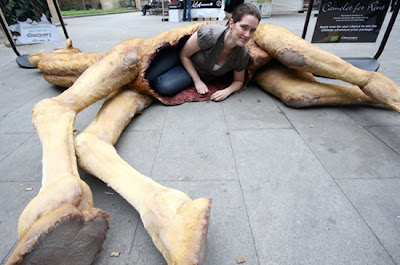
Camelot – A Replica of Bear Grylls’ Famous Camel Carcass

If you’re a fan of Discovery Channel, you know about Bear Grylls’ crazy adventures from “Man vs. Wild”, and chiefly about the famous camel carcass he used to protect himself in the Sahara Desert.

In an original advertising move to endorse the new season of “Man vs. Wild”, Discovery Channel placed a replica of the camel carcass in Sydney’s Wynyard Park and put it up for rent, on a popular website.

Passers-by had the opportunity to crawl inside the carcass, dubbed Camelot, to see how Bear felt during his survival test in Sahara, and also fill in a form telling Discovery why they would be the best tenant for this unusual property, for the chance to win a holiday voucher worth $2,500.

Camelot-Camel-Carcass

Olympic champions show gravel to snatch Asian Games gold

Markis Kido-Hendra Setiawan Olympic champion Markis Kido-Hendra Setiawan of Indonesia had to save two championship points before beating defending Asian Games champions Koo Kien Keat and Tan Boon Heong of Malaysia 16-21, 26-24, 21-19 in the men’s doubles last on Saturday.

The victory also rights the duo’s decision to break away from the Badminton Association of Indonesia (PBSI). The Malaysian pair, who were hoping to emulate Ng Boon Bee-Tan Yee Khan as the only Malaysians to victorious defend the Asian Games badminton gold, will surely rue the two missed opportunities to seal victory.

The pairs had fought tooth and nail right from the opening serve and the score was tied at 16-16 before the Malaysians won five points in a row to take the first game. Lifted by the opening win, the Malaysians continued great the Indonesians and opened up an 8-4 lead, only to be pecked back at 12-12. They then had two chances at 21-20 and 23-22 to wrap but the title but fell 26-24.

It was the Indonesians who were now on the front foot as they raced to a 14-9 lead. Kien Keat-Boon Heong, however, won seven of the next nine points to make it 16-16 but the Indonesians found an extra gear to clinch the rubber 21-19. “They played well and were more daring than us. They took their chances well,” said Boon Heong.

Kien Keat said: “We gave it our all and it’s disappointing to settle for silver. It should have been better. But overall, we do not regret with the way we played in losing the match.”