Showing posts with label Sports News. Show all posts

Sunday, April 10, 2011

Kim Clijsters hesitation for French Open after ankle injury


Kim Clijsters' participation in the French Open is in grave doubt after she injured her ankle at a wedding.

The Australian Open champion was on a break with shoulder and wrist evils when she severely stressed medial and lateral ligaments in her right ankle.

She also tore the pills of the ankle joint and sustained both a haematoma and torn tendon sheath.

A statement on her website said: "Kim's presence in Paris is very uncertain. Her ankle is completely immobilized."

The French Open starts on 22 May, in precisely six weeks, and Clijsters' website stated: "Kim faces a recovery of at least four to six weeks."

The world number two's last competitive match was on 31 March, when she lost to the in-form Victoria Azarenka in the quarter-finals of the Sony Ericsson Open in Miami.

Shortly after her exit from that event, the 27-year-old proclaimed she would be out for a month to deal with shoulder and wrist problems, but her initial plans to return at the Italian Open in Rome in May will have to be revised.

Clijsters has twice been a losing finalist at the French Open, in 2001 and 2003. Last year an ankle injury forced her to miss the tournament.

Monday, January 3, 2011

Plagiarism line over 2016 Olympic logo

Organizers of the Rio Olympics are on the suspicious after similarities between the logo for the 2016 Games and a Colorado-based charity foundation were discovered.

The logo, which was released on New Year's Eve at a huge celebration at Copacabana beach, depicts figures acceptance in a circular motion. It was soon noticed that the design resembles the logo for The Telluride
Foundation, a Colorado charity chaired by Norman Schwarzkopf. 

Take away the legs and the red dancer from the Telluride logo and you have Rio's. It's unquestionably similar. But is it plagiarism?

The director of the Brazilian agency that created the logo says no. Fred Gelli admits that there are similarities between the two, but guaranteed that his design was original. "For some reason, we missed that one," he said.

I posed the plagiarism query to Dan Levy, a graphic designer who also hosts a popular sports podcast. He said it's common for the logos of small businesses to partly cover but that it's unforgivable for a major international sporting event to come up with such an unoriginal design. If the Brazilian press could discover the resemblance between Rio 2016 and Telluride, then surely a research and development team could have done the same.

"These logos are way too close for my liking," Levy wrote in an e-mail. "Even the color dispersal is nearly identical. Somebody got ripped off."

The Telluride Foundation, which has yet to comment on the matter, may not be able to protest too loudly though. It seems that the generous organization did some design-borrowing of its own when it made its logo.

Some have noticed its similarity to "The Dancer" by Henri Matisse.

If simulation is the sincerest form of flattery, Matisse would be satisfied.

My biggest problem with the Rio logo isn't the similarity to Telluride's or the similarity between Telluride's and Matisse, but that the logo itself is dead and boring. Organizers say the design is supposed to stand for "contagious energy, harmonious diversity, exuberant nature and Olympic spirit." I must be missing something.

Monday, December 27, 2010

Pandorama on reappear trail


Meade hopeful Pandorama can get his season back on track

Noel Meade is hoping that Pandorama will enjoy a welcome change of luck on today’s Lexus Chase at Leopardstown.

The seven year old looked set to take high rank in the staying pursues division at the start of the season but things have not gone according to plan so far.

He was forced to miss an intended run at Down Royal after he was found to have blood coming from a nostril and then he made an early fault in the Hennessy at Newbury before being nearly brought down and was pulled up.

"Hopefully we can get Pandorama back on track but it's a rough ask for him," said Meade.

"The season just hasn't gone right for him so far, things have plotted against him but that's the way it goes.

"We've always thought he is the horse to run in this type of race, so we're going there and we're going to give it our best shot.

"The heavy ground should be fine for him."

Tuesday, December 21, 2010

'Singing Mouse' Made With Genetic Modification


Japanese scientists said Tuesday they had produced a mouse that tweets like a bird in a genetically engineered "evolution" which they hope will shed light on the origins of human language.

A team of researchers at the University of Osaka created the animal in their "Evolved Mouse Project," in which they use genetically modified mice that are prone to miscopying DNA and thus to mutations.

"Mutations are the driving force of evolution. We have cross-bred the genetically modified mice for generations to see what would happen," lead researcher Arikuni Uchimura said.

"We checked the newly born mice one by one... One day we found a mouse that was singing like a bird," he said, noting that the "singing mouse" was born by chance but that the trait will be passed on to future generations.

"I was surprised because I had been expecting mice that are different in physical shape," he said by telephone, adding that in fact the project had also produced "a mouse with short limbs and a tail like a dachshund."

The laboratory, directed by professor Takeshi Yagi at the Osaka University's Graduate School of Frontier Biosciences in western Japan, now has more than 100 "singing mice" for further research.

Considering that mutant mice tweet louder when put in different environments or when males are put together with females, Uchimura said their chirps "may be some sort of expressions of their emotions or bodily conditions."

"I know it's a long shot and people would say it's 'too absurd'... but I'm doing this with hopes of making a Mickey Mouse some day," he said.

Sunday, December 19, 2010

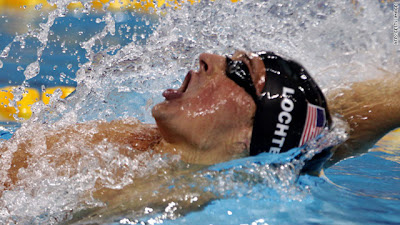
In short, Lochte sets the gold normal

Ryan Lochte

Ryan Lochte doubled his gold medal haul on the final day of the 10th FINA world short route swimming championships in Dubai on Sunday. The American added gold in the men's 200 meter backstroke -- setting a new championship-best time -- and the men's 100 meter person medley.

The 26-year-old also maintained a team gold as the U.S. won the 4x100 medley relay event, taking his gold medal tally to six in Dubai. Sunday's results take his overall medal tally in all short course world championships (which are held in 25 meter pools) to 21, four more than the previous record of 17 held by Sweden's Therese Alshammar.

Lochte's tally of seven medals at the 2010 championships is also a record.

In the women's events, Rebecca Soni secured a clean brush in the breaststroke after adding the 200 meters title to the 50 and 100 meter she won earlier in the week. All her victories came in championship record times. But it was Mireia Belmonte Garcia who was crowned the most successful female swimmer at the championships with four medals.

The Spaniard claimed three gold medals (200 meter butterfly, 200 meter and 400 meter individual medley) and one silver in the 800 meter freestyle.

The United States led the final medal's table with 25, which included 12 golds. Russia finished second on 10 (four golds). Spain were in third place with eight (four golds), while China finished fourth with 14 medals (three golds).

Sunday, December 12, 2010

Frog Bladders clutch Surprises

Australia's desert frogs are famously able to store up large amounts of water in their bladder to last them through the lack. But now researchers from Charles Darwin University in the Northern Territory have found that frog bladders can hold another, even more strange surprise.

Chris Tracy and colleagues report in the Royal Society journal Biology Letters that frogs have a sole way of dealing with foreign objects that become lodged in their bodies: They store and even expel them from the bladder. After finding that frogs implanted with radio transmitters in the field became strangely separated from the devices, the researchers implanted small beads into the body cavities of tree frogs and cane toads to see what would happen.

Within nine days, all the tree frogs had expelled the beads totally from the body via their bladder, while the beads in the cane toads had migrated to the bladder and stayed there. "The bladder of frogs appears to be a sole pathway of expulsion of foreign objects from the body," says Tracy.

Animals such as fish and snakes -- and even humans -- are known to expel objects out of the body through the skin or the intestine. But, says Tracy, they were surprised to find that a two-centimeter-long (0.8-inch-long) transmitter implanted in the body cavity of eight-centimeter-long (three-inch-long) frogs could migrate to the bladder.

"When we first started finding transmitters in bladders, we thought wow that's really bad surgery we did. But when we started seeing them over and over again, we realized, 'Hey, this really is something different.'" Storing from harm's way.

The researchers wanted to know how the bead came to be in the bladder, so they dissected implanted cane toads over a number of days to see where it went. Tracy says tissue grows out from the bladder and wraps around the bead, eventually enveloping it and drawing the bead into the bladder.

"It's pretty remarkable that these amphibians can safely and relatively quickly get rid of potentially dangerous things in the body cavity," he says. So why would frogs have such a special adaptation? Tracy speculates that because frogs eat live insects, some of the sharp insect body parts could break off and become lodged in their body.

"The other thing about frogs is their jumping. They aren't very coordinated and they tend to crash land. They have relatively thin skins, so it's easy to imagine a frog landing on something spiny that could poke into their body that way," he says. "If you have something roaming around inside the body, it's usually a bad thing. It could poke through a vital organ, so it's a good idea to get rid of them."

Tracy says his findings are a cautionary note for other researchers implanting transmitters into animals. "Finding that your study animal has become separated from your transmitter may not mean it has been eaten by a predator. It might have just expelled the object."

Friday, December 10, 2010

Argentina glacier under threat

As world leaders enfold up a climate change summit in Cancun, Mexico, aimed at reaching an emissions deal, countries across the world are witnessing worrying effects of global warming.

Scientists say time is running out to save melting glaciers that give fresh drinking water for millions of people.

Al Jazeera's Teresa Bo reports from the Upsala Glacier, a major body of ice in southern Argentina that is moving back at an alarming rate.

Tuesday, December 7, 2010

Bees see world 5 times quicker than humans

Bees see the world almost five times quicker than humans, says new research.

This gives bumblebees the fastest colour vision of all animals, allowing them to easily find the way shady bushes to find food, says Peter Skorupski and Lars Chittka from the University of London. The ability to see at high speed is common in fast-flying insects allowing them to flee predators and catch their mates’ mid-air.

However, until now it wasn't known whether the bees' full colour vision was able to keep up with their high speed flight. This research sheds new light on the substance suggesting that although slower, it is also about twice as fast as human vision.

Skorupski says: "We can't easily follow a fast flying insect by eye, but they can follow each other, thanks to their very fast vision."

"How fast you can see depends on how quickly the light-detecting cells in your eye can capture snapshots of the world and send them to your brain. Most flying insects can see much quicker than humans, for example so they can avoid getting swatted!" said Skorupski.

Bumblebees use their advanced colour vision in many ways. Skorupski explains: "Bees were the first animals that scientists proved to have colour vision, and they have since been shown to put it to good use; navigating dappled light and shady areas, recognising shapes like their hive entrance, and particularly for finding nectar-bearing coloured flowers."

The experiments show that the bees burn more energy to see in colour than they would to see in monochrome (black and white), raising questions about how they make the most of it.

Liverpool lining up move for Ronaldinho

RonaldinhoLiverpool is the latest in a long list of clubs reportedly pursuing out of favour AC Milan playmaker Ronaldinho. The Brazilian, 30, has become a marginal figure at the San Siro, with boss Massimiliano Allegri preferring Robinho.

Ronaldinho's lack of regular football has led to conjecture his time will be up in January as promises of a new deal have been placed into the background by AC Milan. Itasportpress now claims Liverpool are looking at the former Barcelona man, and Roy Hodgson is said to be looking for an original side-kick to line up alongside Fernando Torres.

Ronaldinho would arrive on a free transfer as his contract at AC Milan expires in June, leaving him free to talk with other clubs. However, Liverpool would have to convince him to drop his €7.5 million (£6.3m) per annum wage stress for the man who has also been linked with moves to Los Angeles Galaxy and a host of Brazilian clubs.

WikiLeaks founder is locked up in Britain in sex case

WikiLeaks founder Julian Assange was arrested and jailed without bail Tuesday in a sex-crimes investigation, but his organization scarcely missed a beat, releasing a new batch of the secret cables that U.S. officials say are destructing America's security and relations worldwide.

A month after dropping out of public view, the 39-year-old Australian surrendered to Scotland Yard to answer a warrant issued for his arrest by Sweden. He is wanted for quizzical after two women accused him of having sex with them without a condom and without their consent.

Assange said he would fight exile to Sweden, setting the stage for what could be a pitched legal battle. And as if to prove that it can't be intimidated, WikiLeaks promptly released a dozen new cables, including details of a NATO defense plan for Estonia, Latvia and Lithuania that made Russia bristle.

The Pentagon welcomed Assange's arrest. "That sounds like good news to me," U.S. Defense Secretary Robert Gates said on a visit to Afghanistan.

WikiLeaks spokesman Kristinn Hrafnsson insisted Assange's arrest and the decision Tuesday by both Visa and MasterCard to stop processing donations to the group "will not change our operation."

Hrafnsson said the organization has no plans yet to make good on its threat to release en masse some of its most sensitive U.S. documents if it comes under attack.

There appeared to be no need.

The U.S. government is investigating whether Assange can be prosecuted for espionage or other offenses. On Tuesday, Pentagon and State Department officials said some foreign officials have suddenly grown reluctant to trust the U.S. because of the secrets spilled by WikiLeaks.

"We have already seen some indications of meetings that used to involve several diplomats and now involve fewer diplomats," said State Department spokesman P.J. Crowley. "We're conscious of at least one meeting where it was requested that notebooks be left outside the room."

Pentagon spokesman Col. Dave Lapan said the military had seen foreign contacts "pulling back."

"Believing that the U.S. is not good at keeping secrets and having secrets out there certainly changed things," Lapan said. The latest batch of confidential U.S. cables could strain relations between Washington and Moscow. The documents show that NATO secretly decided in January to defend the Baltic states of Estonia, Latvia and Lithuania against military attack.

Dmitry Rogozin, Russia's ambassador to NATO, said Tuesday that Moscow will demand that NATO drop the agreement, which he argued is clearly aimed at his country.

"Against whom else could such a defense be intended? Against Sweden, Finland, Greenland, Iceland? Against polar bears, or against the Russian bear?" Rogozin said.

Monday, December 6, 2010

Webber kept injury hidden

Mark Webber has exposed he suffered a broken shoulder in a mountain bike crash during the Formula One title run-in.

The Australian sustained the injury with four grands prix remaining in the season and when holding an 11-point lead over Ferrari's Fernando Alonso at the top of the drivers' standings.

In his book that reviews his championship tilt, Up Front - 2010, A Season To Remember, Webber in no way blames the wound for missing out on the title. He ended up third, 14 points behind winner, and Red Bull team-mate, Sebastian Vettel.

Remarkably, although Webber has confirmed the need for painkilling injections ahead of the races in Japan and Korea, he decided to keep the injury secret from Red Bull team principal Christian Horner.

Only those close to him, in particular trainer Roger Cleary and FIA chief medical officer Gary Hartstein, were aware of the break.

Angler's 405-pound yellowfin tuna is the weightiest on record

yellowfin tunaThere was spirited celebration on the San Diego waterfront Monday morning after the boat Vagabond returned from a long-range fishing trip into Mexican waters and offloaded the heaviest yellowfin tuna ever caught by an angler.

The behemoth, landed by Mike Livingston of Sunland, Calif., weighed 405.2 pounds; it's girth was 61 inches and it précised nearly 86 inches from nose to tail.

Livingston, whose previous large tuna weighed 100 pounds, said he developed a rash while "worrying about how big this fish was going to be."

He was so exhausted after the marathon battle that he quit fishing for the day and caught only one small tuna the remainder of the trip. Vagabond anglers caught eight tuna weighing 200-plus pounds, including two that topped 300 pounds.

The only known previous catch of a yellowfin heavier than Weisenhutter's was a 399-pound specimen caught in 1992 aboard the Polaris Supreme. But because more than one angler handled the rod the catch did not qualify as an IGFA record.

Livingston's fish was trucked to a taxidermist, where mounts will be made for him and the Vagabond Sportfishing office. A brief statement on the Point Loma Sportfishing website read:

"Holy Cow! The Vagabond long-range sport fisher just returned to the dock today with a historic, potential world record mega cow tuna catch. The official weight of 405.2 lbs. was met with cheers, champagne, and congratulations all around."

Thursday, December 2, 2010

Newborn Panda at Atlanta Zoo Is a Boy

It's a boy! The giant panda cub born earlier this month at Zoo Atlanta is a little man with a big belly who is already showing his black and white markings, a zoo spokeswoman said Friday.

Veterinarians had to wait about two weeks before they could pry the baby from its mother long enough for an exam to decide whether it was male or female. "The exam yesterday showed his skin looks good. He's got a nice little belly from nursing. He is doing very well," said spokeswoman Keisha Hines.

The cub was born to 13-year-old giant panda Lun Lun. He is the panda's third offspring with her mate, Yang Yang. And Lun Lun is "doing great. She is a great third time mom," said Hines.

The boy cub, who is the only panda to be born in the United States this year, has not been named yet, since according to Chinese tradition children are not named until they reach 100 days old.

He probably to go on display for the public in late February or early March, Hines said. Lun Lun's other son Xi Lan, who was born in 2008, resides at the Atlanta zoo. Her daughter Mei Lan, born in 2006, was sent to China in February.

Fewer than 1,600 giant pandas are expected to remain in the wild, and some 280 live in zoos around the world.

Ancient Egyptian Lake Discovered From Space

American researchers have said they discovered the bits and pieces of a massive lake in Egypt as large as one of the Great Lakes. The discovery of the over 100,000 years old lake was long-established from space shuttle imagery.

ScienceNews.org reported that the images revealed a lake wider than Lake Erie that once existed a few miles west of the current Nile River. From the time it first appeared about 250,000 years ago, the lake in Egypt’s Tushka region would have grown and shrunk periodically until finally drying up about 80,000 years ago, researchers say.

Knowing where such ancient bodies of water were located helps archaeologists understand the kind of environment encountered by Homo Sapiens migrating out of Africa, study leader Ted Maxwell, a geologist at the Smithsonian National Air and Space Museum in Washington, said in statements to reporters. “You realize that hey, this place was full of really large lakes when people were wandering into the rest of the world,” he says.

Desert winds have eroded and sands have buried much of the region’s landscape, says Maxine Kleindienst, an anthropologist at the University of Toronto, but planned field studies will search for ancient shorelines suggested by the radar images.

Today Egyptians rely almost exclusively on the Nile and its annual floods for their water. The ancient lakes, Maxwell says, suggest that such flooding was already a fixture a quarter million years ago.

FIFA World cup 2018 in Russia

FIFA's World Cup will be held in Qatar in 2022, the leading body said in a press conference Thursday.

The tiny, wealthy Middle Eastern nation beat out the United States, Japan, South Korea and Australia to host what will be the main sporting event in the world in 2022. FIFA president Sepp Blatter confirmed that the ruling body's wish to grow the sport around the world played a big part in the committee's thinking.

The 2018 FIFA World Cup will be held in Russia, the sport's governing body publicized Thursday. The Russian government has promised billions of dollars to build new stadiums and infrastructure. A tournament in Russia would also open a enormous, relatively untapped market for FIFA, which has awarded World Cups to South Africa in 2010 and Japan and South Korea in 2002 for similar reasons.

Russia beat out England and joint bids from Spain/Portugal and Belgium/Netherlands to host what will be the main sporting event in the world in 2018. It will be the first time the contest has been held in Eastern Europe.

Russian Prime Minister Vladimir Putin certain against attending the ceremony in Zurich, but his deputy Igor Shuvalov was present to accept the first successful bid from Eastern Europe.

"You have entrusted us with the FIFA World Cup for 2018 and I can promise that you will never feel sorry it. Let us make history together," he told the assembled delegates.

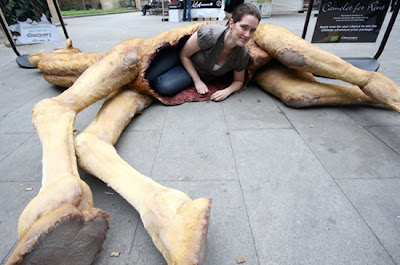
Camelot – A Replica of Bear Grylls’ Famous Camel Carcass

If you’re a fan of Discovery Channel, you know about Bear Grylls’ crazy adventures from “Man vs. Wild”, and chiefly about the famous camel carcass he used to protect himself in the Sahara Desert.

In an original advertising move to endorse the new season of “Man vs. Wild”, Discovery Channel placed a replica of the camel carcass in Sydney’s Wynyard Park and put it up for rent, on a popular website.

Passers-by had the opportunity to crawl inside the carcass, dubbed Camelot, to see how Bear felt during his survival test in Sahara, and also fill in a form telling Discovery why they would be the best tenant for this unusual property, for the chance to win a holiday voucher worth $2,500.

Camelot-Camel-Carcass

Olympic champions show gravel to snatch Asian Games gold

Markis Kido-Hendra Setiawan Olympic champion Markis Kido-Hendra Setiawan of Indonesia had to save two championship points before beating defending Asian Games champions Koo Kien Keat and Tan Boon Heong of Malaysia 16-21, 26-24, 21-19 in the men’s doubles last on Saturday.

The victory also rights the duo’s decision to break away from the Badminton Association of Indonesia (PBSI). The Malaysian pair, who were hoping to emulate Ng Boon Bee-Tan Yee Khan as the only Malaysians to victorious defend the Asian Games badminton gold, will surely rue the two missed opportunities to seal victory.

The pairs had fought tooth and nail right from the opening serve and the score was tied at 16-16 before the Malaysians won five points in a row to take the first game. Lifted by the opening win, the Malaysians continued great the Indonesians and opened up an 8-4 lead, only to be pecked back at 12-12. They then had two chances at 21-20 and 23-22 to wrap but the title but fell 26-24.

It was the Indonesians who were now on the front foot as they raced to a 14-9 lead. Kien Keat-Boon Heong, however, won seven of the next nine points to make it 16-16 but the Indonesians found an extra gear to clinch the rubber 21-19. “They played well and were more daring than us. They took their chances well,” said Boon Heong.

Kien Keat said: “We gave it our all and it’s disappointing to settle for silver. It should have been better. But overall, we do not regret with the way we played in losing the match.”

Tuesday, November 30, 2010

Monkeys Cured of Color Blindness

squirrel monkeyTwo male squirrel monkeys now see the world in an entire new way in full color.
Female squirrel monkeys can see in color, but male squirrel monkeys are normally red-green colorblind because they lack pigments in the retina that notice those wavelengths of light.

Now, researchers have performed gene therapy that permitted two male squirrel monkeys named Sam and Dalton to produce proteins that detect red light. As soon as the red-light-harvesting protein was made in the monkeys' eyes, the animals were able to distinguish between red and green spots in color vision tests, Jay Neitz of the University of Washington in Seattle and his collaborators report online September 17 in Nature.

The experiment wasn't supposed to work, Neitz says. People born with cataracts don't develop nerve relations that help the brain make sense of messages sent by the eye. If the defect isn't corrected early, these people stay essentially blind even if their eyes return to full function later.

Because there was no reason to assume color vision was different from other types of vision, the team had assumed it would not be possible to reverse the deficit in an adult animal.

Neitz polled experts in the vision field on whether they thought producing photoreceptors in colorblind adult monkeys could give color vision. "Every single person said, "absolutely not.'" But the researchers decided to move forward with the experiment to see if they could get the pigment protein to be made in the eye.
Male monkeys lacking the red photoreceptor protein were given injections of a virus carrying a gene for the protein.

Levels of the protein slowly rose in some retinal cells. After 20 weeks, Neitz and his colleagues started to see differences in the way Sam and Dalton performed on daily color vision tests. Around that time, protein production levels peaked and the monkeys have maintained stable color vision for two years since treatment.

Still, the monkeys' actual sensation of color what it looks like to them remains a mystery?

"The achievement is technically amazing and conceptually very cool," says Melissa Saenz, a neuroscientist at Caltech in Pasadena, Calif. But even though the monkeys can distinguish some new wavelengths of light, "there's no proof that the monkeys recognize a new dimension of color," she says. For example, the monkeys may now perceive red and green as different shades of yellow and blue, colors the animals already knew.

"If it doesn't involve experiencing new sensations of color, it would not dramatically change the experience of colorblind people if the treatment were valid to humans," Saenz says.

West Ham 4 - 0 Man Utd

west-hamRampant West Ham booked a first League Cup semi-final for 20 years after banging holders Manchester United out of the Carling Cup at snowy Upton Park. Former Red Devil Jonathan Spector was in inspired form, scoring with a header and a close-range finish to nick his first goals in English football.

The disjointed visitors, before unbeaten this season, conceded again as Carlton Cole nodded in after the break. Cole then turned Jonny Evans to fire simply past Tomas Kuszczak.

Though Manchester United manager Sir Alex Ferguson predictably did not select his strongest team, the preliminary XI could still boast the likes of Ryan Giggs, Darren Fletcher and Javier Hernandez. So it still registers as something of a shock that West Ham, bottom of the Premier League, ran out such persuasive and deserved winners against the league leaders - especially in light of the Londoners' poor start to this season.

And under-pressure Hammers boss Avram Grant may now insist they are over their bad patch after a performance that was rich in assure, both individually - Nigerian striker Victor Obinna was hugely impressive as he created all four goals - and collectively.

The match started fast in freezing conditions, with both teams attacking each other as the play moved quickly from end-to-end. Obinna even tried an determined free-kick from over 30 yards before the end, displaying the confidence coursing through the veins of a west Ham side which notched their biggest win over United in 80 years.

World's Incredible Glaciers Caves

These are the amazing pictures from the 'Ice Man' - a frosty photographer who is prepared to go to strange lengths to capture the perfect picture. Eric Guth is the real life Jack Frost spending days hiding out in some of the world's most spectacular glacier caves. The 30-year-old regularly camps for days inside the eerie glaciers which can reach incredible temperatures sometimes as low as 20 degrees below freezing.

His adventures to find the perfect icy picture have taken him all over the world - from Patagonia in South America to Iceland in the North Atlantic. As these amazing pictures show his trips are well worth it as he captures the dramatic beauty of these hidden low temperature landscapes.

Eric, from Portland, USA, said 'I have been enthralled with ice for as long as I can remember so I can't imagine doing anything else.' 'My mum was a photographer and when she passed her camera down to me, taking pictures of glaciers just seemed like the natural thing to do.' 'I have been known to camp out for anything up to four or five days.'

'Some of the caves are minute and I can cover the whole thing in an hour or so but some take days to explore and I like to cover every nook and cranny.' 'The long camping trips can be pretty strong and it's definitely a change from the sun I am used to at home but I love it.'

'I've made it my mission to track down the most spectacular glaciers in the world and while I have seen dozens already the sight always takes my breath away'.